
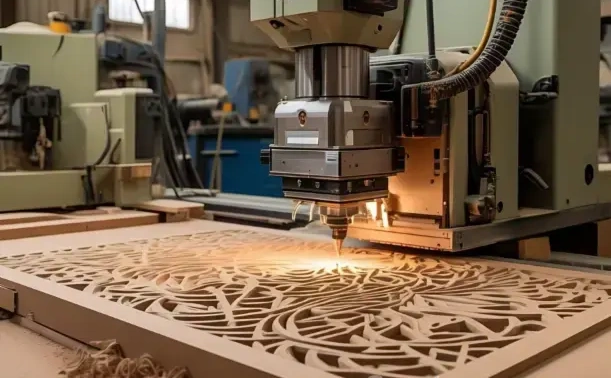
Deep routed MDF cabinet doors (8–12mm carving depth) are increasingly popular in some export markets.
However, many factories experience:
- Edge chipping after CNC routing
- Fiber tearing along carved profiles
- Excessive sanding before primer
- Inconsistent paint absorption
These issues are often blamed on CNC machines or cutting tools.
But in many cases, the real cause lies in the board structure itself.
1. Density Is Not the Only Factor
Many buyers focus only on board density (e.g., 730kg/m³ vs 800kg/m³).
While density affects hardness,
it does not fully determine routing stability.
For deep carving applications, internal bonding strength (IB) plays a critical role.
Low bonding strength means:
- Fibers separate under cutting stress
- Edges lose structural support
- More sanding is required
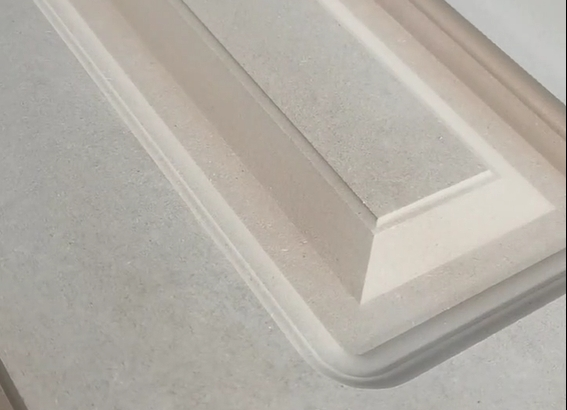
2. Why Deep Routing Increases Risk
When carving depth exceeds 8mm:
- Internal stress increases
- Edge stability becomes more sensitive
- Weak fiber bonding becomes visible
Boards that perform well for flat panel doors
may fail under deep profile routing.
This is why some cabinet factories notice:
“The surface looks fine, but the edge breaks.”
3. What to Check Before Changing CNC Settings
Before adjusting feed speed or replacing tools, check:
✔ Internal bonding strength
✔ Density consistency across batches
✔ Moisture content stability
✔ Fiber structure uniformity
Material consistency directly impacts sanding workload and finishing quality.
4. The Practical Impact on Production
Factories producing painted routed doors have reported:
- Reduced sanding time
- Cleaner carving edges
- More consistent primer absorption
- Lower rework rates
when switching to higher bonding strength boards designed for CNC routing.
For deep routed cabinet doors,
performance is not just about density —
it is about structural integrity.
If your factory is producing routed MDF doors above 8mm carving depth,
material specification deserves careful evaluation.